Know your balance.
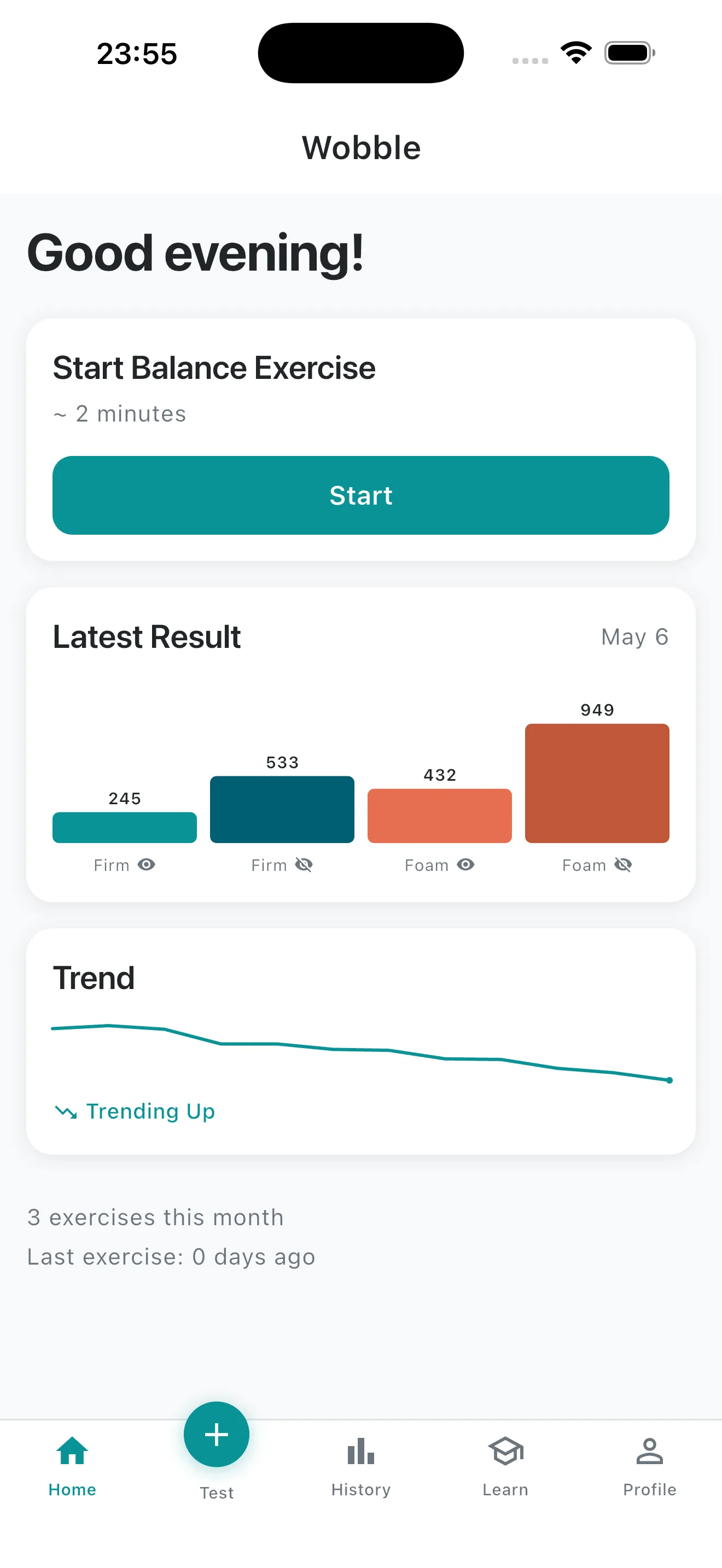
Four 30-second standing rounds. One stability score.
A 2-minute balance test for your phone. Four standing rounds, one stability score, tracked over time — so you'd notice if it changed.
Why measure it?
Balance is the easiest thing to lose without noticing.
How steady you feel isn't how steady you are.
Research finds little correlation between actual balance and the sense of it. Most people learn they've drifted only after they grab a railing — or don't.
It starts drifting from your 40s onward.
Postural control declines steadily from the 40s onward, and the slope steepens past 60. A small drop year over year reads as "fine" day-to-day — until it isn't.
Vision and body-sense cover for the inner ear.
They compensate without telling you. Close your eyes, stand on something soft, and the cover breaks — which is what Wobble's four conditions reveal.
It tells you if you're getting steadier.
Whether you're working on your balance alone or with a coach, the score tells you whether it's helping. "I feel steadier" on its own is just a hunch.
How balance works
Three senses. Four conditions. One honest picture.
Standing balance is three things working together to keep you upright. Wobble varies surface and eye state to isolate which one is doing the work.
The setup is inspired by a method physios have used for decades to see which sense is carrying the load — a modified Romberg test, also known as mCTSIB. Wobble adapts the idea for your phone and your kitchen, as a fitness check, not a clinical assessment.
Vision
Close your eyes and visual cues disappear. Sway should grow — gracefully.
Touch & Body Sense
A foam pad dulls your sense of where your feet are. The body leans on the other two systems.
Inner Ear
What's left when eyes and feet are challenged. Eyes-closed on foam is its hardest day.
The four conditions · 30 seconds each · about 2 minutes total
Four 30-second recordings plus brief setup screens between conditions add up to about two minutes — the kind of test you can do in your kitchen.
How it works
Four steps. One score that builds over time.
Pick your test.
Choose a Full, Half, or Extended test. The wizard walks you through stance and surface so you know exactly what's coming.

Hold your phone to your chest.
Stand with your feet together. Hold the phone in landscape mode flat against your sternum, with both hands. The phone becomes a rigid sensor pinned to your torso — every wobble you make, it records.

Stand still through four 30-second conditions.
Audio cues prompt eyes-open and eyes-closed; the foam-switch screen appears between firm and foam pairs. Stay still for each one — the app counts down and tells you when to move.

See your score.
A per-condition steadiness scale, three plain-language insight cards, and a stability score you can track over time.

Built with care
Safety first. Privacy by default.
Wobble is built to keep you steady — and to keep your data on your phone.
Safety
Stay Steady alert.
If you sway past a threshold, the phone fires an audible alert + haptic — a heads-up to steady yourself.
Auto-stop, by design.
Past a sharper threshold sustained for half a second, the test stops itself. No score is worth a fall.
Progressive unlocks.
Harder stances (heel-to-toe, single-leg) unlock only after you've shown you're steady on the easier ones. Once unlocked, they stay unlocked — the progression is one-way and supportive.
Privacy
Default: local-only.
No account, no email. Sessions, scores and notes live on your phone. Nothing leaves your device unless you ask it to.
Opt-in 1 — Compare With Others.
Share anonymized data to see how you compare to others your age. We may publish aggregated statistics. Never your individual records.
Opt-in 2 — Per-coach link.
Pair a specific coach with a 6-character code. They see your sessions until you revoke. Each coach is consented separately.
Behind Wobble
Built by Florian, in Tyrol & Vienna.
Wobble exists because of something I couldn't feel. During a coordination training with my training group, on the exercises that required eyes closed, I noticed I was performing noticeably worse than the people I was coaching — which is how I found out my own vestibular system doesn't work the way it's supposed to.
By trade I'm a developer and a parkour coach; I also coach athletics, with a neuroathletic focus. For my bachelor's thesis I built VestiCore — an open-source, head-mounted device that gives real-time auditory feedback on your balance, to help train it. Wobble is the measurement side of the same interest, built alongside my Master's in Medical Informatics at TU Vienna.
If you'd like dedicated balance coaching, or have feedback that would make Wobble better, I'd love to hear it. Every note gets read.
Get in touch →
Two minutes. Know where you stand.
For coaches & trainers
Watch every client's balance evolve.
Link a client with a one-time code and follow their balance over weeks. It starts with their actual sway — the path their body traces while standing still — and goes as deep as you want.
Coach access is by request and paid — accounts and rates are issued individually.

You're invisible until they approve
The client reads you a 6-character code; you enter it. Nothing appears on your dashboard until they tap Approve in the app.
- You see their age group, optional self-ratings, every test, and the raw motion data — never their name or email
- The client can revoke you in one tap, any time
- No account or email needed on their side
Sensory reliance
How this client copes when a sense is challenged — outward = holds up better, toward the centre = a weak point. Here inner ear is the weak link.
- This client
- Their own ±1σ (variation)
- Average Wobble user
- Wobble users — typical range
This session vs Wobble users
This session on the Wobble-users ruler, read against the client's own typical level — toward the centre = steadier than most Wobble users, outward = worse. Distance is in σ.
- This session
- Your typical (median)
- Your ±1σ
- Average Wobble user (z = 0)
Shown for foam · eyes closed — the coach view has an overview plus all four conditions.
Brackets, side by side
Tag sessions into coach-defined brackets and compare them per condition — a distribution against the client's own normal range, plus a paired pre→post change view.
0 = the client's own historical median; the shaded band is their normal range.